The First Four Metres: Nine UK Front Gardens That Work Harder Than a Doormat
Front gardens get a rough deal. They are expected to be tidy, welcoming, useful and invisible all at once. They hold the bins, the bikes, the parcels, the odd recycling crate and, somehow, still need to look presentable when February arrives and everything else has given up. The good news is that the first few metres of a UK home do not need a full landscape redesign to earn their keep. They need a plan.
These nine lessons come from the kind of front gardens that do not shout about themselves: terraces with narrow strips, semis with a driveway edge, and new-builds with a square of lawn and a hopeful shrub. None of them turned the front garden into a car park or a bin corridor. They simply made small, sensible moves that suit British weather and real budgets.
1. Start with a bin plan, not a plant plan
The most useful front gardens decide where the wheelie bins live before anything goes in the ground. A simple screen of treated slats, a low hedge or a slim store can hide the bins without pretending they do not exist. The trick is access: leave enough room to wheel them out without scraping knuckles on a gatepost. In narrow terraces, a bespoke-looking screen made from ready-made fence panels and a couple of posts is often cheaper than a fancy bin store, and it looks far better than three bins lined up like waiting taxis.
2. Let a hedge do two jobs at once
A low hedge is not just decoration. It can soften the boundary, hide the bin zone and add a bit of privacy without turning the front garden into a fortress. Hardy choices such as yew, privet or hornbeam work well in most UK plots, but the budget version is often a simple box or lavender hedge in a raised bed. Keep it low enough to see over and wide enough to look deliberate. The aim is a calm green edge, not a giant conifer that swallows the front window.
3. Make the path wider than you think
Many front paths are barely wide enough for one person carrying a bag of shopping. If the path is being lifted or re-laid anyway, take the chance to make it more generous. A clear route of around 1.2 metres feels much easier, especially when bikes, buggies or delivery parcels are involved. Permeable gravel, reclaimed bricks or simple concrete pavers can all work. The point is not a grand entrance; it is a route that does not force everyone into single file.
4. Build a bench that also stores something
A narrow bench near the front wall can be surprisingly useful: somewhere to sit while pulling off muddy boots, a place to park a delivery box, or a spot to wait for a lift. A simple built-in bench with a lift-up seat gives you hidden storage for small tools, bird food or the odd bag of grit. In smaller plots, a wall-mounted folding bench is a clever compromise. It looks intentional, costs less than a full joinery job and does not block the path when it is folded away.
5. Give bikes a proper home
Cycle storage at the front of a UK home is always a compromise, but it does not have to be an eyesore. A covered rack tucked beside the bin screen, a wall anchor under a small lean-to, or a slim metal cycle store can keep bikes out of the hallway. Check whether your local authority or freeholder has rules about front structures before bolting anything down. The best solution is usually the one you will actually use in the rain, not the one that looks best in a catalogue.
6. Plant for February, not just June
A front garden that only looks good in midsummer is a front garden that looks sad for most of the year. Use evergreen structure as the backbone, then add winter interest that can cope with cold, wet and wind. Hellebores, winter box, sarcococca and evergreen ferns are all good value. Grasses add movement without demanding much. Repeat a few hardy pots by the door so the entrance has colour even when the border is doing very little. It is a small budget move with a long season of payback.
7. Use pots to solve awkward edges
New-build front gardens often have odd little strips of paving, a metre of gravel and a boundary that does not quite make sense. Pots can bridge those gaps without a digger. Group three or five in different sizes, use the same colour family and choose plants that tolerate wind. Large pots are easier to keep stable and need less watering than tiny ones. If space is tight, put them on castors so they can be moved when the bins need to come through.
8. Add light without wiring
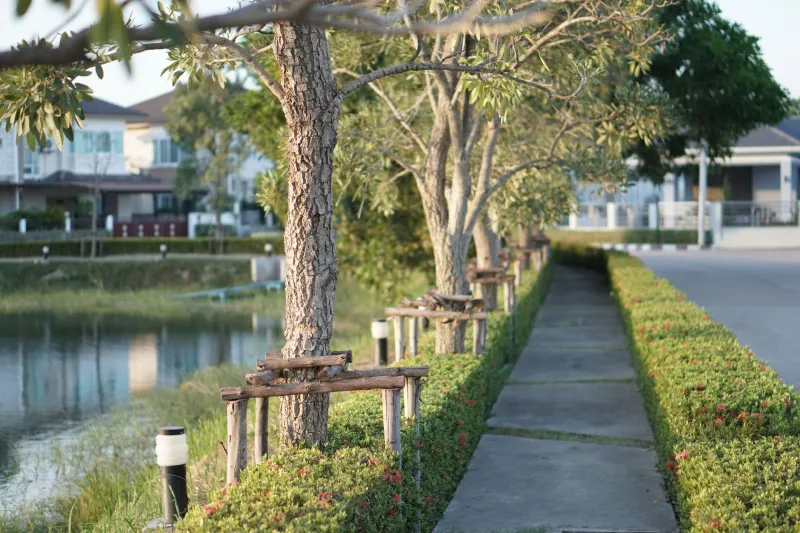
A couple of solar bollards or a warm wall light can make a front garden feel cared for without a big electrical bill. Keep it simple: light the path, not the whole street. A small solar spotlight aimed at a shrub or house number is often enough. Avoid cold blue-white light, which makes even the best planting look like a car park. Warm white is kinder to brickwork and much more welcoming when you come home after dark.
9. Keep the car park feeling at bay
A front garden does not have to become a driveway to be practical. If you need parking, keep a clear planted edge or a strip of gravel so the front does not read as pure hardstanding. If you do not need parking, resist the urge to pave the whole plot for convenience. A mix of path, planting and a small seating or storage zone will usually look better and deal with rain more gracefully. The first few metres can be useful without being utilitarian.
The best front gardens are not the ones with the biggest budget. They are the ones that answer the awkward questions early: where do the bins go, how does the bike get through, what looks decent in February, and how much maintenance can we honestly keep up with? Get those right and the kerb appeal takes care of itself. No doormat required.